
🔢 Sprouts Maths
Maths with Teacher Hope
Reception to Year 6. A friendly test, a learning pack made for your child, and real writing on paper, marked from a photo.
 1. Friendly testYour child writes answers on paper. Teacher Hope finds where to start in every topic.
 2. A pack just for themYou choose: fill the gaps first, mix, or only their school year.
 3. Learn and writeTeacher Hope teaches one small step with pictures, then your child writes 5 answers.
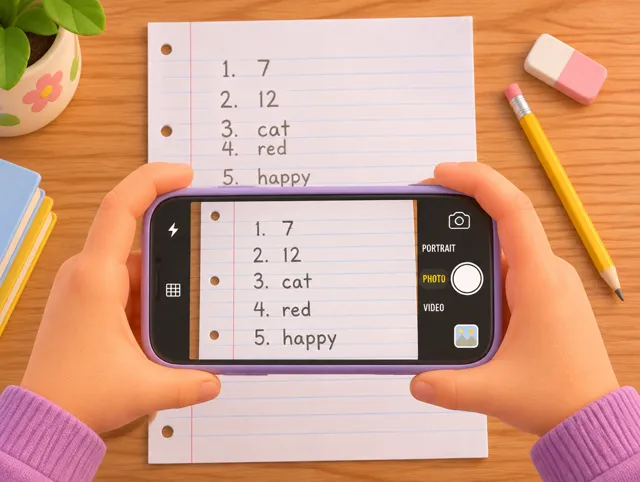 4. Scan and snapScan the page's QR code with a phone and send one photo. Teacher Hope reads the handwriting and marks every answer.
 5. GrowKind feedback on every answer, a star for each lesson and notes for you.
What's in Sprouts Maths
238 lessons so far, each with teaching, a worked example and two sets of written questions.
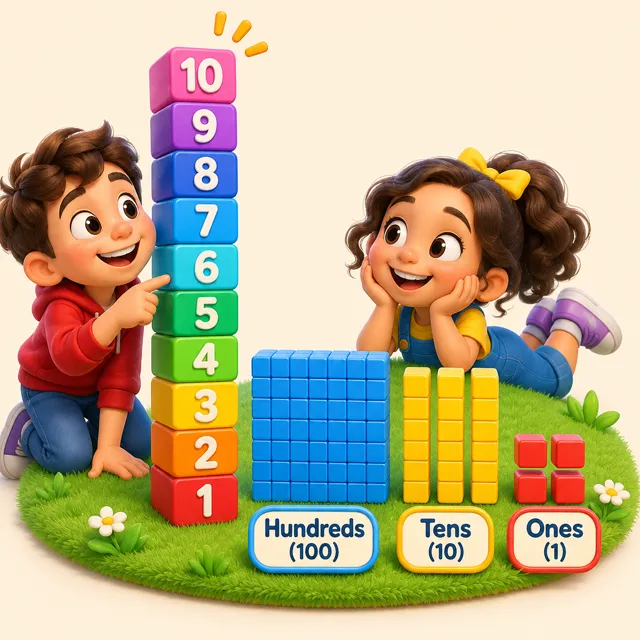
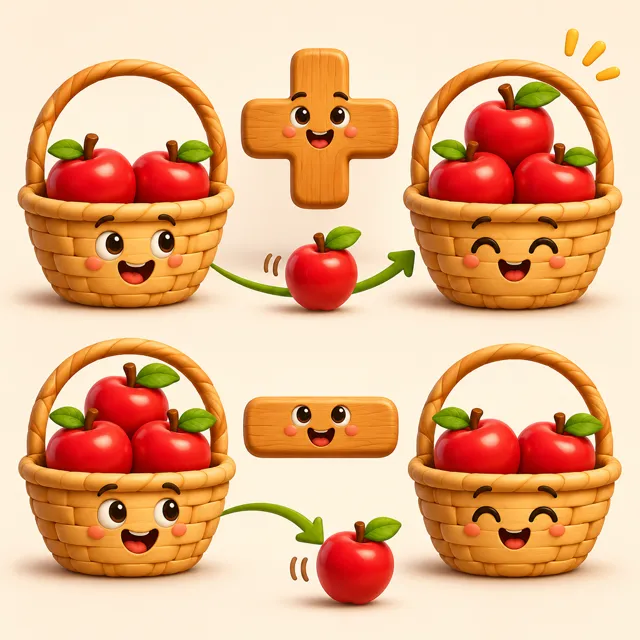
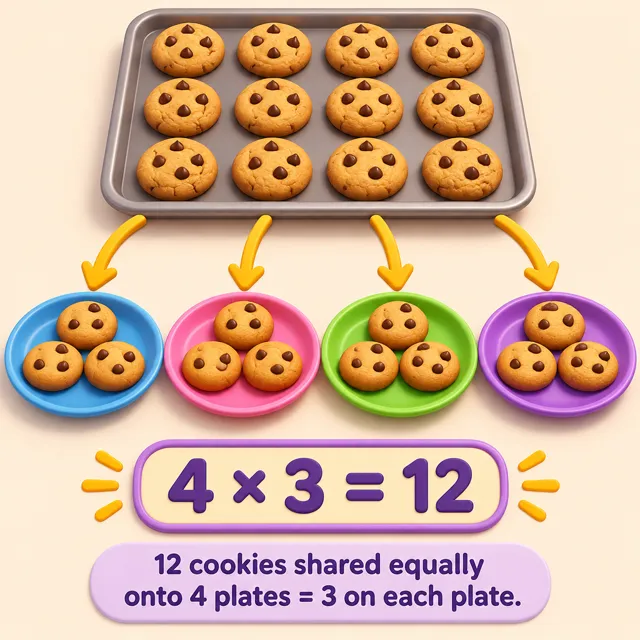
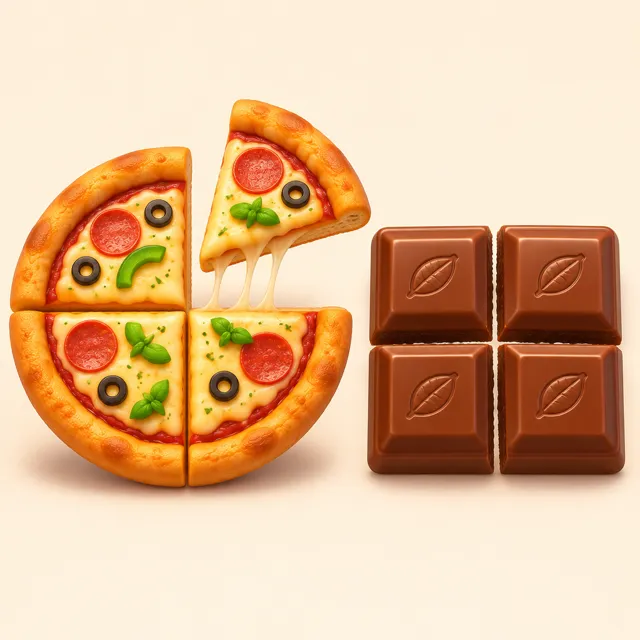
Reception
🔢 Number & place value
- Match, sort and compare: Match and sort objects into groups, and compare two groups to say which has more, fewer or the same.
- Counting to 5: Count up to 5 objects, saying one number for each, and write the numeral to show how many.
- Seeing numbers in a flash: Recognise small amounts up to 5 without counting (subitise), in dot patterns, on fingers and on a ten frame.
- Numbers to 10: Count objects to 10, recognise amounts on a ten frame and say which group has more or fewer.
- One more, one less and on to 20: Find one more and one less than a number to 10, and count and recognise numbers beyond 10 to 20.
➕ Adding & taking away
- Parts and whole: Know that a number can be split into two parts, and find the missing part to make 5 or 10.
- Number bonds to 10: Recall pairs of numbers that make 5 and 10, using fingers and a ten frame.
- Adding two groups: Combine two groups to find how many altogether within 10, by counting all or counting on.
- Taking away: Take away objects from a group within 10 and count how many are left.
- Number stories: Solve simple adding and taking away story problems within 10, drawing pictures to show what happens.
✖️ Times & sharing
- Doubling: Know that doubling means two groups of the same amount, and find doubles to double 5.
- Sharing fairly: Share a group of objects equally between 2 (or 3) and say how many each one gets.
- Equal groups: Make equal groups and tell whether groups are equal or not equal.
- Halving: Find half of a small even number of objects by sharing them into 2 equal groups, and know that halving is the opposite of doubling.
- Pairs, odd and even: Put objects into pairs and groups of 2, and spot that some numbers make pairs (even) and some have one left over (odd).
📏 Measuring, money & time
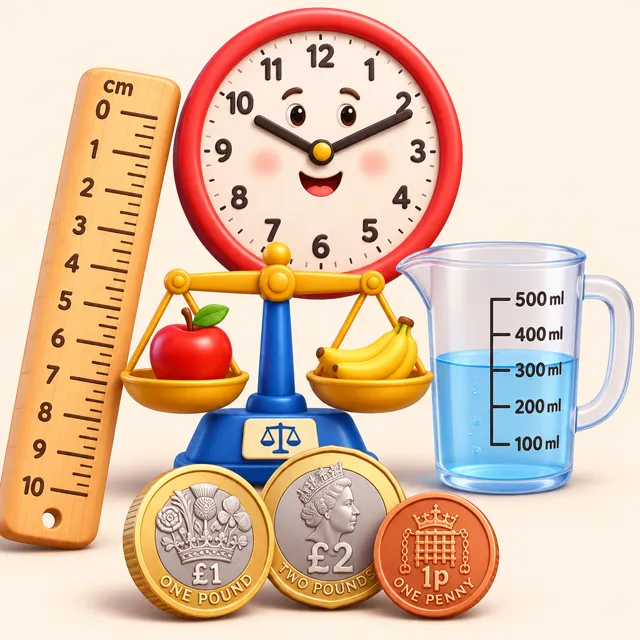
- Longer, shorter, taller: Compare lengths and heights using the words longer, shorter and taller.
- Measuring with cubes: Measure the length of objects by lining up cubes with no gaps, and compare lengths by counting cubes.
- Heavy, light, full and empty: Compare the weight of objects using heavier and lighter, and describe containers as full, half full or empty.
- First, then, next: Put events in time order and use words such as first, then, next, morning and night.
- Days of the week: Say the days of the week in order and use the words today, tomorrow, yesterday and weekend.
🔺 Shapes & position
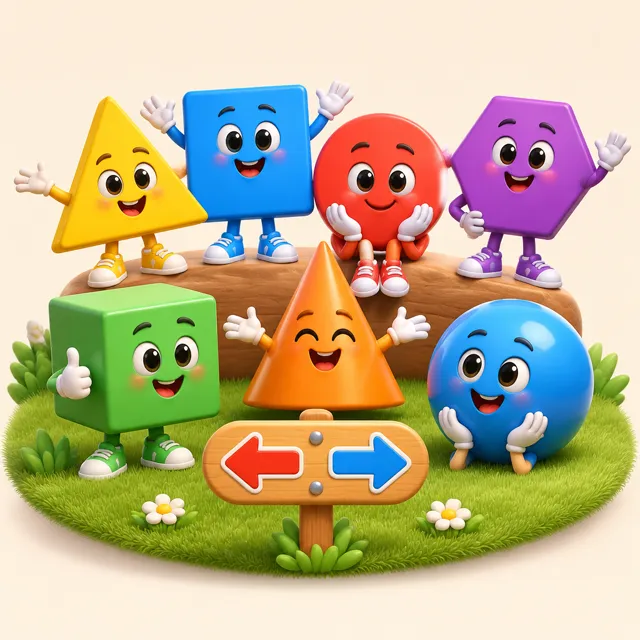
- Circles, triangles and squares: Name circles, triangles, squares and rectangles and talk about their sides and corners.
- Solid shapes: Explore 3D shapes such as a cube, sphere and cylinder, and say whether they roll or stack.
- Making new shapes: Put shapes together to make new shapes, and find smaller shapes inside bigger shapes.
- Patterns and positions: Continue and make repeating patterns, and use words like on, under and next to to say where things are.
- Maps and directions: Describe where things are using next to, between and in the middle, and count steps forwards along a path.
Year 1
🔢 Number & place value
- Numbers to 20: Count, read and write numbers to 20 in numerals and words, and find one more and one less.
- First, second, third: Use ordinal numbers (1st, 2nd, 3rd …) to describe position in a line or a race.
- Tens and ones: Partition 2-digit numbers to 50 into tens and ones, and read and write them.
- Numbers to 100: Count, read and write numbers to 100, and partition them into tens and ones.
- Comparing numbers to 100: Count forwards and backwards to and across 100, and compare numbers using <, > and =.
➕ Adding & taking away
- Number bonds and fact families: Use the part-whole model to know number bonds within 10 and write related addition and subtraction facts.
- Take away and find the difference: Subtract within 10 by taking away and counting back, and find the difference between two numbers.
- Adding and subtracting within 20: Add and subtract one-digit and two-digit numbers within 20, including by making 10 and counting back.
- Number bonds to 20: Use number bonds to 10 to find number bonds to 20, and write the related addition and subtraction facts.
- Missing numbers: Solve missing number problems such as 7 = ? − 9, and one-step word problems using addition and subtraction.
✖️ Times & sharing
- Counting in 2s, 5s and 10s: Count forwards in steps of 2, 5 and 10.
- Equal groups and arrays: Make and count equal groups and arrays, and write them as repeated addition.
- Making doubles: Make doubles of numbers to 10 by making two equal groups, and know doubles facts.
- Sharing and grouping: Solve one-step problems by sharing equally and by putting objects into equal groups.
🍕 Fractions & decimals
- Equal parts: Tell whether a shape or amount is split into equal parts, ready to find halves and quarters.
- Halves of shapes: Recognise, find and name a half as one of two equal parts of a shape.
- Half of an amount: Find half of a small quantity by sharing it into 2 equal groups.
- Quarters: Recognise, find and name a quarter as one of four equal parts of a shape or quantity.
📏 Measuring, money & time
- Measuring length: Compare lengths and heights, and measure them in centimetres using a ruler.
- Heavier and lighter: Compare masses using heavier, lighter and balance, and measure mass in cubes on a balance.
- Full and empty: Compare capacity and volume using full, half full, empty, more and less, and measure capacity in cups.
- Coins and notes: Recognise and know the value of different coins and notes, and count totals of coins.
- Days, months and time words: Sequence events using before and after, and name the days of the week and the months of the year in order.
- O'clock and half past: Tell the time to the hour and half past the hour, and draw the hands on a clock face.
🔺 Shapes & position
- 2D shapes: Recognise and name common 2D shapes, and count their sides and corners (vertices).
- 3D shapes: Recognise and name common 3D shapes (cube, cuboid, sphere, cylinder, cone) and describe their faces.
- Shape patterns: Sort shapes and make and continue repeating patterns with shapes.
- Position and turns: Describe position using words such as left, right, above and below, and describe whole, half and quarter turns.
- Moving on a grid: Describe position and movement using left, right, up and down, counting squares on a grid.
Year 2
🔢 Number & place value
- Tens and ones: Recognise the place value of each digit in a two-digit number (tens, ones) and partition numbers into tens and ones.
- Numbers in words: Read and write numbers to 100 in numerals and in words.
- Counting in 2s, 3s, 5s and 10s: Count in steps of 2, 3 and 5 from 0, and in tens from any number, forwards and backwards.
- Number lines to 100: Identify, represent and estimate numbers on number lines to 100.
- Comparing and ordering numbers: Compare and order numbers from 0 up to 100; use <, > and = signs.
➕ Adding & taking away
- Number bonds to 10 and 100: Recall and use addition and subtraction facts to 10 and 20 fluently, and use them to find related facts to 100.
- Adding and subtracting ones and tens: Add and subtract a two-digit number and ones, and a two-digit number and tens, using concrete objects, pictures and mental methods.
- Adding three numbers: Add three one-digit numbers, looking for number bonds to 10 and doubles, and know that addition can be done in any order.
- Adding two 2-digit numbers: Add and subtract two two-digit numbers, including crossing ten, and use the inverse to check answers.
- Subtracting two 2-digit numbers: Subtract a two-digit number from a two-digit number, including exchanging a ten for ten ones, and check with addition.
✖️ Times & sharing
- Equal groups and arrays: Recognise equal groups and arrays, and write multiplication as repeated addition using the × and = signs.
- Multiplication in any order: Show that multiplication can be done in any order (it is commutative) but division cannot, using arrays.
- The 2, 5 and 10 times tables: Recall and use multiplication and division facts for the 2, 5 and 10 multiplication tables, including recognising odd and even numbers.
- Sharing and grouping: Calculate division by sharing and grouping, write it using the ÷ and = signs, and solve problems using multiplication facts.
🍕 Fractions & decimals
- Halves and quarters: Recognise, find, name and write fractions 1/2, 1/4, 2/4 and 3/4 of a shape, and know that 2/4 is the same as 1/2.
- Thirds: Recognise, find, name and write the fractions 1/3 and 2/3 of a shape, and know that 3/3 makes a whole.
- Fractions of amounts: Find 1/2, 1/4, 1/3, 2/4 and 3/4 of a set of objects or a quantity.
- Counting in halves and quarters: Count forwards and backwards in halves and quarters, and know that two halves or four quarters make a whole.
📏 Measuring, money & time
- Money: Recognise and use the symbols for pounds (£) and pence (p); find totals of coins, make amounts in different ways and find change.
- Measuring length in cm and m: Choose and use centimetres and metres to measure length to the nearest centimetre with a ruler, and compare lengths.
- Mass in grams and kilograms: Choose units and measure mass in grams (g) and kilograms (kg) by reading scales, and compare masses.
- Capacity and temperature: Measure and compare capacity in millilitres (ml) and litres (l), and read temperature in degrees Celsius (°C).
- Length, mass and capacity: Choose and use standard units to estimate and measure length (cm, m), mass (g, kg), capacity (ml, l) and temperature (°C); read scales and compare measures.
- Telling the time: Tell and write the time to five minutes, including quarter past and quarter to the hour, and know the number of minutes in an hour.
- Hours, minutes and days: Know the number of minutes in an hour and hours in a day, and compare and find simple durations of time.
🔺 Shapes & position
- 2D shapes: Identify and describe the properties of 2D shapes, including the number of sides, vertices and lines of symmetry.
- 3D shapes: Identify and describe the properties of 3D shapes, including the number of faces, edges and vertices, and find 2D shapes on the faces of 3D shapes.
- Sorting and drawing 2D shapes: Compare and sort 2D and 3D shapes by their properties, and draw 2D shapes.
- Turns and directions: Use mathematical vocabulary to describe position, direction and movement, including quarter, half and three-quarter turns, clockwise and anticlockwise.
- Moving on a grid: Describe position and movement on a grid, including routes with more than one step, using left, right, up and down.
📊 Charts & data
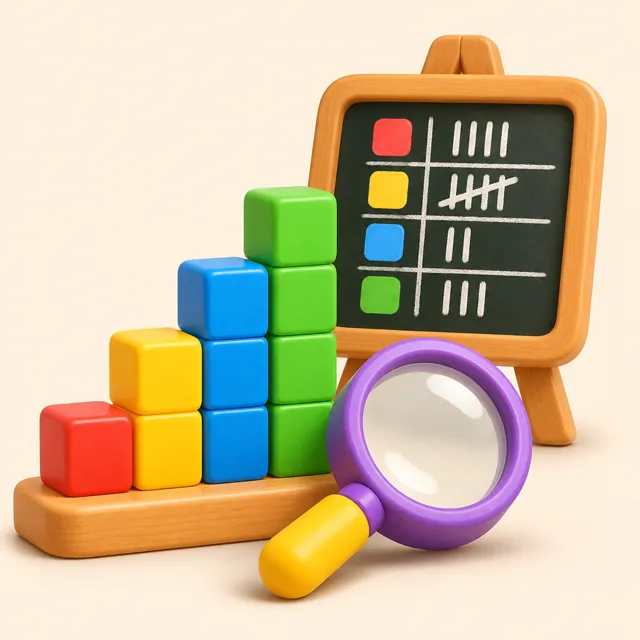
- Tally charts: Interpret and construct simple tally charts, and use them to count and compare.
- Tables: Read and complete simple tables, and use them to answer questions about totals and comparisons.
- Pictograms: Interpret and construct simple pictograms, including where one symbol stands for 2, and answer questions by counting and comparing.
- Block diagrams and bar charts: Interpret simple block diagrams and tables; ask and answer questions about totalling and comparing.
Year 3
🔢 Number & place value
- Hundreds, tens and ones: Recognise the place value of each digit in a three-digit number (hundreds, tens, ones) and partition numbers in different ways.
- Numbers in words: Read and write numbers up to 1000 in numerals and in words.
- Numbers on a number line to 1000: Identify, represent and estimate numbers up to 1000 on number lines.
- 10 and 100 more or less: Find 10 or 100 more or less than a given number, and count from 0 in multiples of 4, 8, 50 and 100.
- Comparing and ordering to 1000: Compare and order numbers up to 1000 using <, > and =.
➕ Adding & taking away
- Mental adding and subtracting: Add and subtract numbers mentally, including a three-digit number and ones, a three-digit number and tens, and a three-digit number and hundreds.
- Column addition: Add numbers with up to three digits using the formal written method of column addition, and estimate to check answers.
- Column subtraction: Subtract numbers with up to three digits using the formal written method of column subtraction, and use the inverse to check answers.
- Estimate and check: Estimate the answer to a calculation and use inverse operations to check answers.
- Solving addition and subtraction problems: Solve problems, including missing number problems and two-step problems, using addition and subtraction.
✖️ Times & sharing
- The 3, 4 and 8 times tables: Recall and use multiplication and division facts for the 3, 4 and 8 multiplication tables.
- Multiplying by 10 and related facts: Multiply by 10 and use known multiplication facts to work out related calculations with multiples of 10.
- Multiplying 2-digit by 1-digit numbers: Write and calculate multiplications of a two-digit number by a one-digit number, using mental and written methods.
- Dividing and remainders: Divide a two-digit number by a one-digit number, including answers with remainders, and check using multiplication.
- Scaling and correspondence problems: Solve problems involving multiplication and division, including scaling ('times as many') and correspondence problems.
🍕 Fractions & decimals
- Unit fractions, non-unit fractions and tenths: Recognise, find and write unit and non-unit fractions of a shape, and count up and down in tenths.
- Fractions of amounts: Find unit and non-unit fractions of a set of objects or a quantity using division.
- Equivalent fractions, comparing and adding: Recognise and show equivalent fractions with small denominators; compare and order fractions; add and subtract fractions with the same denominator within one whole.
- Comparing and ordering fractions: Compare and order unit fractions, and fractions with the same denominator.
- Adding and subtracting fractions: Add and subtract fractions with the same denominator within one whole.
📏 Measuring, money & time
- Length and perimeter: Measure, compare, add and subtract lengths (m, cm, mm), and measure the perimeter of simple 2D shapes.
- Measuring mass: Measure, compare, add and subtract masses in grams and kilograms, reading scales.
- Measuring capacity and volume: Measure, compare, add and subtract volume and capacity in litres and millilitres, reading scales.
- Money: pounds and pence: Add and subtract amounts of money to give change, using both £ and p in practical contexts.
- Telling the time to the minute: Tell and write the time from an analogue clock to the nearest minute, including Roman numerals I to XII; know the number of seconds in a minute; find durations.
- Units of time and durations: Know the number of seconds in a minute and days in each month, year and leap year; use a.m. and p.m.; compare durations of events.
🔺 Shapes & position
- Right angles and turns: Recognise angles as a property of shape or a description of a turn; identify right angles, and whether angles are greater or less than a right angle.
- Horizontal, vertical, parallel and perpendicular lines: Identify horizontal and vertical lines and pairs of perpendicular and parallel lines.
- 2D and 3D shapes: Draw 2D shapes and recognise 3D shapes in different orientations, and describe them using faces, edges and vertices.
- Faces, edges and vertices: Recognise 3D shapes in different orientations and describe them using faces, edges and vertices.
📊 Charts & data
- Tally charts: Collect and record data in tally charts, and answer one-step and two-step questions about them.
- Pictograms with a key: Interpret and present data using pictograms where one symbol stands for more than one, and solve one-step and two-step questions.
- Bar charts: Interpret and present data using bar charts with scales, and solve one-step and two-step questions.
- Tables: Interpret and present data using tables, and solve one-step and two-step questions using information in tables.
Year 4
🔢 Number & place value
- Numbers to 10,000: Recognise the place value of each digit in a four-digit number (thousands, hundreds, tens and ones) and partition numbers in different ways.
- Comparing and ordering to 10,000: Compare and order numbers beyond 1,000, and identify and estimate numbers on a number line to 10,000.
- Rounding to 10, 100 and 1,000: Round any number to the nearest 10, 100 or 1,000.
- Counting in 6s, 7s, 9s, 25s and 1,000s: Count in multiples of 6, 7, 9, 25 and 1,000, and find 1,000 more or less than a given number.
- Negative numbers: Count backwards through zero to include negative numbers, and compare and order negative numbers.
- Roman numerals to 100: Read and write Roman numerals to 100 (I to C) and understand that the system did not use zero.
➕ Adding & taking away
- Adding and subtracting 1s, 10s, 100s and 1,000s: Mentally add and subtract ones, tens, hundreds and thousands to and from four-digit numbers.
- Column addition with exchanges: Add numbers with up to four digits using the formal written method of column addition, including exchanges.
- Column subtraction with exchanges: Subtract numbers with up to four digits using the formal written method of column subtraction, including exchanges across zeros.
- Estimate and solve two-step problems: Estimate and use inverse operations to check answers, and solve two-step addition and subtraction problems in context.
✖️ Times & sharing
- Multiplying and dividing by 10 and 100: Multiply and divide whole numbers by 10 and 100, understanding how the digits move.
- Times tables to 12 × 12: Recall multiplication and division facts for multiplication tables up to 12 × 12, including multiplying by 0 and 1.
- Factor pairs and multiplying three numbers: Recognise and use factor pairs and commutativity in mental calculations, and multiply three numbers together.
- Multiply by a 1-digit number: Multiply two-digit and three-digit numbers by a one-digit number using the formal written layout.
- Divide by a 1-digit number: Divide two-digit and three-digit numbers by a one-digit number, using short division and known facts, including remainders.
- Scaling and correspondence problems: Solve problems involving multiplying and adding, including the distributive law, scaling and correspondence problems.
🍕 Fractions & decimals
- Equivalent fractions: Recognise and show, using diagrams, families of common equivalent fractions.
- Add and subtract fractions: Add and subtract fractions with the same denominator, including totals greater than one whole.
- Fractions of amounts: Find unit and non-unit fractions of quantities, and solve problems involving fractions of amounts.
- Tenths and hundredths: Recognise and write decimal equivalents of tenths and hundredths, and divide one- or two-digit numbers by 10 and 100.
- Halves, quarters and hundredths as decimals: Recognise and write decimal equivalents of 1/4, 1/2 and 3/4, and count up and down in hundredths.
- Comparing, ordering and rounding decimals: Compare numbers with the same number of decimal places up to two decimal places, and round decimals with one decimal place to the nearest whole number.
📏 Measuring, money & time
- Area by counting squares: Find the area of rectilinear shapes by counting squares.
- Perimeter and kilometres: Measure and calculate the perimeter of rectangles and rectilinear shapes in cm and m, and convert between kilometres and metres.
- Money: pounds and pence: Estimate, compare and calculate different amounts of money in pounds and pence.
- 12-hour and 24-hour time: Read, write and convert time between analogue and digital 12-hour and 24-hour clocks.
- Converting units of time: Solve problems converting from hours to minutes, minutes to seconds, years to months and weeks to days.
🔺 Shapes & position
- Acute, obtuse and right angles: Identify acute and obtuse angles and compare and order angles up to two right angles by size.
- Triangles, quadrilaterals and symmetry: Compare and classify triangles and quadrilaterals by their properties, and identify lines of symmetry in 2-D shapes.
- Completing symmetric figures: Identify lines of symmetry and complete a simple symmetric figure with respect to a given line of symmetry.
- Plotting points and drawing polygons: Describe positions on a 2D grid as coordinates in the first quadrant, and plot specified points and draw sides to complete a given polygon.
- Coordinates and translation: Describe positions on a 2-D grid as coordinates in the first quadrant, describe movements as translations, and plot points to complete a polygon.
📊 Charts & data
- Read bar charts: Interpret and present discrete data using bar charts and pictograms.
- Drawing bar charts: Present discrete data in a bar chart using a suitable scale, and use it to answer questions.
- Time graphs: Interpret continuous data in time graphs (line graphs) and the tables they come from.
- Comparison, sum and difference: Solve comparison, sum and difference problems using information presented in tables and charts.
Year 5
🔢 Number & place value
- Numbers to one million: Read, write, order and compare numbers to at least 1,000,000 and determine the value of each digit.
- Counting in powers of 10: Count forwards or backwards in steps of powers of 10 (10, 100, 1,000, 10,000 and 100,000) for any number up to 1,000,000.
- Rounding big numbers: Round any number up to 1,000,000 to the nearest 10, 100, 1,000, 10,000 and 100,000.
- Roman numerals to 1,000: Read Roman numerals to 1,000 (M) and recognise years written in Roman numerals.
- Negative numbers: Interpret negative numbers in context, count forwards and backwards through zero and calculate intervals across zero.
➕ Adding & taking away
- Add large numbers: Add whole numbers with more than four digits using the formal written method (column addition).
- Subtract large numbers: Subtract whole numbers with more than four digits using the formal written method (column subtraction).
- Mental addition and subtraction: Add and subtract numbers mentally with increasingly large numbers, choosing an efficient strategy.
- Inverse operations and missing numbers: Use the inverse to find missing numbers and to check answers to addition and subtraction.
- Multi-step problems: Solve addition and subtraction multi-step problems in contexts, deciding which operations to use and why, and use rounding to check answers.
✖️ Times & sharing
- Factors, multiples and primes: Identify multiples and factors, including factor pairs; know and use prime numbers; recognise square and cube numbers.
- Square and cube numbers: Recognise and use square numbers and cube numbers, and the notation for squared (²) and cubed (³).
- Multiply and divide by 10, 100 and 1,000: Multiply and divide whole numbers and those involving decimals by 10, 100 and 1,000.
- Long multiplication: Multiply numbers up to four digits by a one- or two-digit number using a formal written method, including long multiplication for two-digit numbers.
- Short division with remainders: Divide numbers up to four digits by a one-digit number using short division, and interpret remainders appropriately for the context.
- Multiplication and division problems: Solve problems involving multiplication and division, including scaling, and decide what to do with remainders.
🍕 Fractions & decimals
- Equivalent fractions: Identify, name and write equivalent fractions of a given fraction, represented visually, including tenths and hundredths, and simplify fractions.
- Mixed numbers and improper fractions: Recognise mixed numbers and improper fractions, convert from one form to the other, and compare and order fractions whose denominators are multiples of the same number.
- Add and subtract fractions: Add and subtract fractions with the same denominator and denominators that are multiples of the same number, including mixed numbers.
- Multiply fractions by whole numbers: Multiply proper fractions and mixed numbers by whole numbers, supported by materials and diagrams.
- Fractions of amounts: Find fractions of amounts and quantities, and find the whole when a fraction of it is known.
- Decimals to three places: Read, write, order and compare numbers with up to three decimal places, recognise thousandths, and round decimals with two places to the nearest whole number and to one decimal place.
- Decimals and percentages: Recognise the per cent symbol, understand that per cent means parts per hundred, and write percentages as fractions and decimals.
- Add and subtract decimals: Add and subtract decimals with up to three decimal places, including money and measures, using column methods.
📏 Measuring, money & time
- Perimeter and area: Measure and calculate the perimeter of rectilinear shapes, and calculate and compare the area of rectangles (including squares) using cm² and m².
- Area on squared paper: Find the area of rectilinear shapes by counting squares, and estimate the area of irregular shapes.
- Converting metric units: Convert between different units of metric measure (km and m, m and cm, cm and mm, kg and g, litres and ml).
- Metric and imperial units: Understand and use approximate equivalences between metric units and common imperial units such as inches, pounds and pints.
- Converting units of time: Solve problems involving converting between units of time: seconds, minutes, hours, days, weeks, months and years.
- Measurement problems: Use all four operations to solve problems involving measure (length, mass, volume and money) using decimal notation, including scaling.
- Volume: Estimate volume and capacity, and find the volume of cuboids by counting cubes and using cubic centimetres (cm³).
🔺 Shapes & position
- Measuring and classifying angles: Know angles are measured in degrees; estimate, compare and classify acute, obtuse, right and reflex angles.
- Measuring and drawing angles: Estimate angles, and draw and measure them in degrees using a protractor.
- Missing angles: Identify angles at a point and one whole turn (360°), angles at a point on a straight line (180°) and other multiples of 90°, and calculate missing angles.
- Rectangles and regular polygons: Use the properties of rectangles to find missing lengths and angles, and tell regular and irregular polygons apart by reasoning about sides and angles.
- 3-D shapes: Identify 3-D shapes, including cubes and other cuboids, from 2-D pictures, and describe their faces, edges and vertices.
- Reflection and translation: Identify, describe and represent the position of a shape following a reflection or translation, using coordinates and the appropriate language.
📊 Charts & data
- Line graphs: Read and interpret information in line graphs, and the tables of data behind them.
- Drawing and reading line graphs: Draw line graphs from tables of data, choosing a sensible scale, and read values from them.
- Tables and timetables: Complete, read and interpret information in tables, including timetables.
- Two-way tables: Solve comparison, sum and difference problems using information presented in two-way tables.
Year 6
🔢 Number & place value
- Numbers to ten million: Read, write, order and compare numbers up to 10,000,000 and find the value of each digit.
- Rounding big numbers: Round any whole number to a required degree of accuracy.
- Negative numbers: Use negative numbers in context and calculate intervals across zero.
- Number puzzles and problems: Solve number and practical problems that involve place value, rounding and negative numbers up to 10,000,000.
➕ Adding & taking away
- Adding and subtracting big numbers: Add and subtract whole numbers with more than 4 digits using formal written (column) methods.
- Inverse and estimating: Use inverse operations to find missing numbers, and use estimation to check answers.
- Mental methods with big numbers: Perform mental calculations with large numbers, choosing efficient strategies such as partitioning, rounding and adjusting, and counting on.
- Multi-step problems: Solve addition and subtraction multi-step problems in context, deciding which operations to use and why.
✖️ Times & sharing
- Common factors and multiples: Identify common factors, common multiples, the highest common factor and the lowest common multiple of numbers.
- Primes, squares and cubes: Identify prime numbers and prime factors, and calculate with square and cube numbers.
- Long multiplication: Multiply numbers of up to 4 digits by a two-digit number using long multiplication.
- Short and long division: Divide numbers up to 4 digits by a two-digit number using short and long division, and interpret remainders in context.
- Order of operations: Use knowledge of the order of operations (brackets, then multiply and divide, then add and subtract) to carry out calculations.
🍕 Fractions & decimals
- Simplify, compare and order fractions: Use common factors to simplify fractions and use common multiples to compare and order fractions.
- Calculating with fractions: Add and subtract fractions with different denominators and mixed numbers, multiply simple pairs of fractions and divide fractions by whole numbers.
- Multiply and divide fractions: Multiply simple pairs of proper fractions, writing the answer in its simplest form, and divide proper fractions by whole numbers.
- Decimals and powers of 10: Identify the value of each digit in numbers given to three decimal places, and multiply and divide numbers by 10, 100 and 1,000 giving answers up to three decimal places.
- Multiply decimals: Multiply one-digit numbers with up to two decimal places by whole numbers.
- Divide decimals and fractions as division: Divide decimals by whole numbers, give remainders as decimals, and use division to find decimal equivalents of fractions such as 3/8.
- Fractions, decimals and percentages: Recall and use equivalences between simple fractions, decimals and percentages, and find percentages of amounts.
📏 Measuring, money & time
- Converting units: Convert between standard units of length, mass and volume using decimals to three places, and between miles and kilometres.
- Measurement problems: Solve problems involving the calculation and conversion of units of measure, using decimal notation up to three decimal places, including miles and kilometres.
- Area and perimeter: Calculate the area of rectangles, parallelograms and triangles, and recognise that shapes with the same area can have different perimeters.
- Area on grids and compound shapes: Find the area of triangles, parallelograms and compound rectilinear shapes, and recognise that shapes with the same area can have different perimeters and vice versa.
- Volume of cuboids: Calculate the volume of cubes and cuboids using cubic units, and solve problems involving volume.
🔺 Shapes & position
- Classifying and drawing shapes: Compare and classify 2-D shapes based on their properties and sizes, and draw 2-D shapes using given dimensions and angles.
- Missing angles: Find missing angles in triangles, quadrilaterals and regular polygons, on a straight line, around a point and where lines cross.
- Circles and 3-D shapes: Name parts of circles, including radius and diameter, knowing the diameter is twice the radius; recognise and describe 3-D shapes and their nets.
- Nets of 3-D shapes: Recognise, describe and build simple 3-D shapes, including making nets.
- Coordinates, translation and reflection: Describe positions on the full coordinate grid (all four quadrants), and draw and translate simple shapes and reflect them in the axes.
📊 Charts & data
- Tables and graphs: Interpret and use line graphs, bar charts, timetables and two-way tables to solve problems.
- Line graphs and conversion graphs: Interpret and construct line graphs, including conversion graphs, and use them to solve problems.
- Pie charts: Interpret pie charts and use them to solve problems, including working out angles for each sector.
- The mean: Calculate and interpret the mean as an average, and solve problems using the mean.
🧩 Ratio & algebra
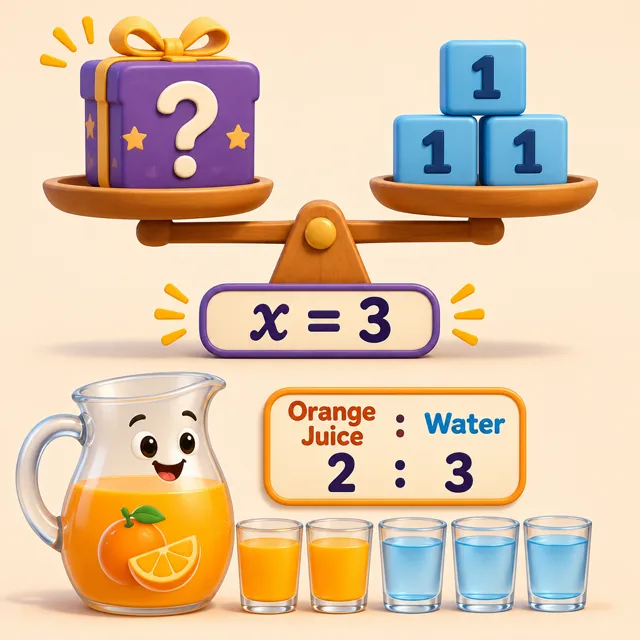
- Ratio and proportion: Solve problems involving ratio, proportion and scale factors, including sharing in a given ratio.
- Scale factors: Solve problems involving similar shapes where the scale factor is known or can be found, and use scale in maps, models and recipes.
- Using letters for numbers: Use letters to stand for unknown numbers, write simple expressions from words, and substitute values into expressions.
- Formulae and sequences: Use simple formulae, function machines and linear number sequences, and express missing number problems algebraically.
- Solving equations: Solve one-step and two-step equations, and find pairs of numbers that satisfy an equation with two unknowns.
Questions from parents
Why does my child write on paper instead of tapping answers?
Writing by hand is how children remember. Tapping a choice lets them guess; writing shows what they really know, and builds handwriting and setting out work. You take one photo of the page and Teacher Hope marks it.
What happens to the photos?
The photo is sent once to our AI marking service, marked, and then thrown away. We never store photos. Only the marks and Teacher Hope's short notes are saved, under a made-up nickname. Please photograph only the page, not your child.
My child is in Year 4 but finds some topics hard. Will they be stuck on Year 4 work?
No. The friendly test finds the starting point in each topic separately. If fractions need Year 2 work but number is fine, fractions start at Year 2 and number at Year 4. You choose: fill the gaps first, mix gaps with year-group lessons, or only follow the year group.
What does it follow?
The National Curriculum for England, in the order many schools teach it: small steps, concrete objects and pictures before numbers (maths), and a sounds-first phonics approach with grammar taught through writing (English). It covers number and place value, adding and taking away, times tables and sharing, fractions and decimals, measuring, money and time, shapes, charts, and in Year 6 ratio and algebra.
How do we send the photo from a computer?
Every worksheet shows its own QR code. Scan it with a phone, take one photo of the page and send it: Teacher Hope marks it and the marks appear on the computer straight away. Each code belongs to one child and one page and works once, so photos never get mixed up, even when many children send work at the same time.
Who marks the work?
Teacher Hope marks every answer from the photo: right, nearly or not yet, with a short note on each one, a score, and one thing to practise next. You can see every marked page on the grown-ups panel.
Is it free?
Yes. A grown-up signs in with Google to save progress, then makes a profile for each child (up to 6).
More learning · English · Piano · Parents